The accredited Vein Center at Fox Valley Plastic Surgery expertly treats all vein issues. Some practices have a doctor, instead of a registered vascular technician, perform the ultrasounds. This is never done at FVPS because a registered vascular sonographer is vastly superior to a doctor in his/her level of ultrasound expertise of the veins.

Varithena™
The management of varicose tributary veins of the great saphenous vein has traditionally been treated with radio-frequency ablation or endovenous laser ablation. Now there is a new non-thermal non-tumescent ablation procedure called Varithena®. Varithena (polidocanol injectable foam) is a prescription medicine used to treat varicose veins caused by problems with the great saphenous vein (GSV) and other related veins in the leg’s GSV system. Varithena improves symptoms related to or caused by varicose veins, and the appearance of varicose veins.
Our skilled surgeons and technicians are helping women and men from places such as Green Bay, Appleton, Fond du Lac, Sheboygan, Milwaukee, Madison, upper Michigan and beyond perfect their personal Renaissance. Contact the Vein Center at 920-233-1540 to request a vein consultation.

How Varithena Works
Treatment with Varithena is a nonsurgical procedure. First, the provider will fill the problem area of your vein with a small amount of Varithena using a small tube called a catheter or with an injection. Varithena is a foam that flows into the area and causes the problem vein to collapse. This allows your blood flow to shift to nearby healthy veins. The foam is deactivated when it comes in contact with blood.
What To Expect
Treatment with Varithena is minimally invasive and nonsurgical. The provider usually numbs the injection site, but no additional anesthesia is required. The provider administers a small amount of Varithena through a catheter or by direct injection into the malfunctioning vein. It usually takes less than 30 minutes to administer Varithena. Following administration, the provider applies bandages and compression stockings to the leg.
Benefits
In 2 placebo-controlled studies, most patients treated with Varithena (polidocanol injectable foam) experienced these results:
- Improved symptoms: The majority of patients reported improvement in symptoms including heaviness, achiness, swelling, throbbing, and itching (HASTI™ Symptoms).
- Improved vein appearance: The majority of patients experienced improved vein appearance in assessments by both patients and doctors.
Treatment Plan
You may see results with as little as one treatment, depending on the number and size of your varicose veins. However, additional treatment may be necessary if the size and extent of the veins to be treated require more than the maximum dose of Varithena per session. Treatment sessions are separated by a minimum of 5 days.
Day of Procedure
Patients need to remember to bring their compression hose to the appointment. The entire procedure takes less than 30 minutes without requiring the use of tumescent anesthesia. Using ultrasound technology, the provider inserts a needle to locate the varicose vein wall. The Varithena solution is injected into the needle which then travels throughout the diseased vein, causing it to close. Symptoms begin to alleviate immediately. Additionally, there is very little down time, and patients are able to walk out the door.
To learn more about this procedure, contact the Vein Center at Fox Valley Plastic Surgery at 920-233-1540 to request a personal vein consultation.
Recovery
You may resume light activities as quickly as the same day of treatment. Avoid heavy exercise for 1 week after the treatment. Walk at least 10 minutes a day for 1 month, and avoid long periods of inactivity.
The provider will apply bandages and a compression stocking to the treated area, which should remain dry. The compression stockings must be worn day and night for the next 3-14 days depending on the treated vein. Compression stockings must be continuously worn for up to 2 weeks (14 days total) depending on the vein. The provider will tell you the amount of days to wear the hose, and whether to wear thigh-high or knee-high stockings.
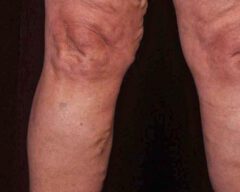
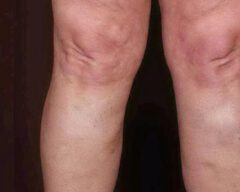
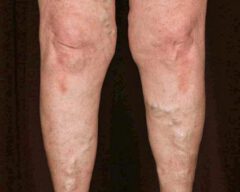
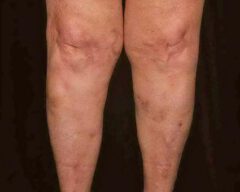
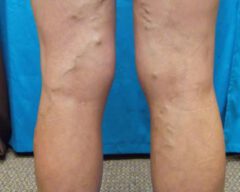
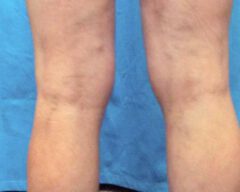
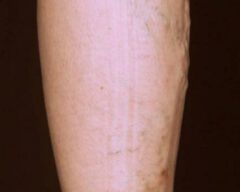
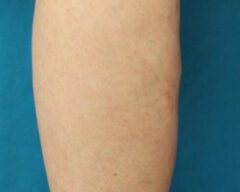
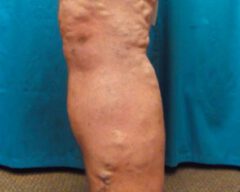
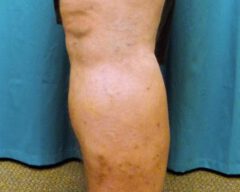
Before & Afters
Real Patients real results
Risks
Like all medical procedures, treatment with Varithena may cause side effects in some patients. The most common side effect is leg pain or discomfort. In the majority of cases, leg pain stops within one week. The other common side effects are injection site bruising or pain, and potentially serious blood clots in the leg veins. These are not all the possible side effects of Varithena.
You should not be treated with Varithena if you are allergic to polidocanol or have clots in your blood vessels. Severe allergic reactions have been reported in people treated with liquid forms of polidocanol and some patients have died from these reactions.
The following medical conditions may preclude you from being a candidate for Varithena: arterial disease (a disease of the blood vessels), reduced mobility, a history of blood clots in the veins or lungs, major surgery in the past 3 months, a recent long hospital stay, or becoming pregnant or recently pregnant.
Real Patients stories

“I feel better at 45 than I did at 30!”
- Lisa

“Do it sooner, rather than later.”
- Paul

Pricing
While many insurance carriers cover varicose vein treatment, some individual insurance companies may limit the types of therapy which are covered. In particular, coverage may depend on the severity of the varicose veins and symptoms. We will check to see if your plan covers this expensive, but safer treatment. Our experience with insurance pre-authorization showed coverage with AARP, Humana Gold, Blue Cross Blue Shield (Anthem), and WEA, but coverage changes routinely so pre-authorization is required. Patients are still ultimately responsible for any co-pays, deductibles, and any other non-covered insurance charges.
Cash vs. Insurance
- Patients with a high deductible insurance plan, may feel they will never meet the deductible and prefer to pay a cash price. We offer special pricing for patients who elect to personally pay for a procedure. The insurance allowed amount is generally much higher than the out of pocket cost.
- Some patients want a procedure done right away and do not want to wait for a prior authorization decision from their insurance plan. This can be accomplished by paying for the procedure out of pocket.
- Some patients do not have insurance. We offer special pricing for procedures that are not billed to insurance. Full payment must be made before a procedure is performed.
- Patients who wish to pay for their procedures out of pocket, need to waive their right to insurance coverage for their procedures.
Patients without insurance or who do not wish to use insurance, should call for an individual consultation to get a custom quote for vein treatment.
We recommend the purchase of Dermaka Cream for $34 to minimize bruising and inflammatory responses of the skin after a procedure. It works best by applying it five days before a procedure, and then after the procedure until no longer needed. Our patients have had excellent results with the cream, which can also be used for eczema, rashes, dry skin, etc. Learn more on Dermaka.com, or download the patient booklet here.
Start Your journey today
Take the first step toward renewed confidence with a consultation at Fox Valley Plastic Surgery. Our team is here to listen, guide, and help you achieve results that feel true to you.