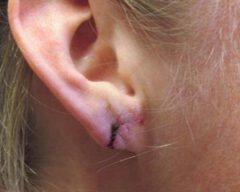
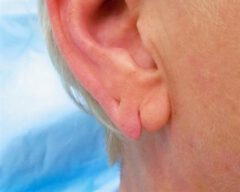
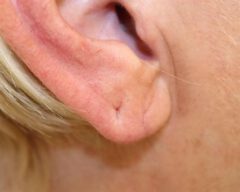
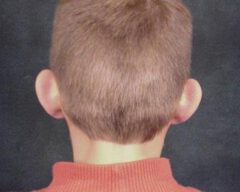
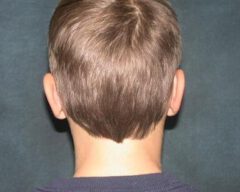
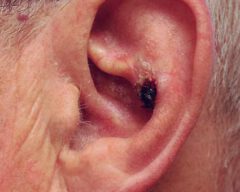
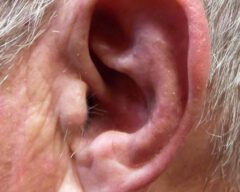
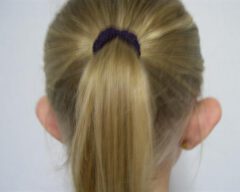
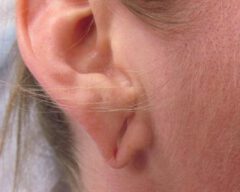
Earlobe surgery or repair is a reconstructive plastic surgery procedure performed to restore the appearance of earlobes that have been torn or stretched due to ear tearing, trauma or piercing, including the insertion of ear gauges.

Without an earring, a stretched earlobe will shrink, but never look normal again without surgery. Patients should wait until the ear finishes shrinking on its own before considering surgery. Earlobe repair can also close normal ear piercings, when a patient no longer desires a piercing.

EARLOBE REPAIR: KEY DETAILS

  • Procedure Time: 30-60 minutes
  • Anesthesia: Local numbing
  • Recovery: Immediate
  • Results: 2 weeks for simple repairs. Up to 6 months for complex gauge repairs.
  • Approximate Cost: $100 Consult fee. Simple repairs $600 per earlobe, complex repairs starting $900 per earlobe. More about pricing below.

What To Expect

Procedure

Earlobe repair is a minor surgical procedure used to correct torn, stretched, or enlarged earlobes, including damage caused by earrings, trauma, or stretched piercings.

Depending on the injury, torn earlobe repair may be performed soon after the tear occurs or delayed until the area has healed and inflammation has resolved. The surgical technique depends on the type of injury and the amount of tissue involved.

During the procedure, the provider carefully removes damaged tissue and reshapes the earlobe to restore a natural appearance. Specialized suturing techniques are used to precisely close the incision and help minimize visible scarring. In some cases, small tissue flaps may be used to improve the shape and contour of the earlobe.

Earlobe repair is typically performed in the office under local anesthesia as an outpatient procedure, allowing patients to return home the same day.

Repairing Stretched or Enlarged Piercing Holes

Stretched, elongated, or unwanted piercing holes can also be surgically closed. After numbing the earlobe with local anesthesia, the provider removes a small amount of skin around the opening and carefully stitches the area closed.

For very small defects, only a small amount of tissue may need to be removed before the front and back of the earlobe are closed with sutures. Larger stretched openings may require additional reshaping to restore the natural contour of the earlobe.

If you choose to have your ears pierced again after healing, the new piercing should be placed in a slightly different location rather than directly through the scar tissue.

Earlobe Repair Recovery

Recovery after earlobe repair is generally straightforward. Once the local anesthetic wears off, patients may experience mild discomfort for a day or two. Acetaminophen is typically sufficient for managing minor discomfort.

In most cases, extensive bandaging is not necessary. A thin layer of antibiotic ointment may be recommended, and the repaired area should be kept clean to help reduce the risk of infection.

Most patients can return to work and normal daily activities immediately after the procedure. If non-dissolvable stitches are used, they are typically removed after approximately one week. Dissolvable sutures do not require removal.

Patients will notice an immediate improvement in the shape of the earlobe after complex gauge repair. While most swelling and bruising resolve within the first few weeks, the earlobe and surgical scar will continue to improve over several months. Final results are typically seen within 3 to 6 months, although scars may continue to fade and mature for up to a year.

When Can I Re-Pierce My Ears After Earlobe Repair?

Ears can generally be pierced again 2 to 6 months after earlobe repair. Fox Valley Plastic Surgery typically recommends waiting at least 3 months to allow the earlobe adequate time to heal.

The new piercing should not be placed directly through the surgical scar. Your provider can help determine an appropriate location and timing for re-piercing.

If a bothersome keloid scar develops after a new piercing, treatment options may include injections or surgical removal.

Potential Risks of Earlobe Repair

Earlobe repair is generally a safe procedure when performed by a qualified and experienced surgeon, but all surgical procedures carry some risk. Potential complications can include infection, bleeding, scarring, changes in earlobe shape, or problems with wound healing.

Infections can usually be treated with antibiotics. In rare cases, an additional procedure may be necessary to drain an infected area.

Schedule an Earlobe Repair Consultation

If you have a torn earlobe, stretched piercing hole, or enlarged earlobe piercing, Fox Valley Plastic Surgery can help determine the best approach for restoring the shape and appearance of your earlobe. To learn more about earlobe repair, contact Fox Valley Plastic Surgery today at 920-233-1540 to schedule a consultation.
 

Jay Garrow, PA

Pricing

Earlobe repair consultations are available at our Oshkosh office. A non-refundable $100 consultation fee is required and is separate from the cost of the procedure.

Because earlobe repair is considered a cosmetic procedure, it is not covered by insurance.

Earlobe repair pricing generally starts at:

  • Torn or elongated piercing repair: $600 per earlobe or $1,000 for both earlobes
  • Complex earlobe or gauge repair: $900 per earlobe or $1,500 for both earlobes

Depending on the extent of the damage and complexity of the repair, the total cost may be up to $2,000. The surgical approach and pricing may also vary depending on whether you plan to re-pierce or re-gauge your ears after healing.

Our provider, Jay Garrow, PA-C will evaluate your earlobes, discuss your goals, and provide a personalized treatment plan and final cost during your consultation.

Frequently Asked Questions

How long do sutures stay in after earlobe repair?

Sutures are typically removed 5–7 days after earlobe repair. We’ll provide you with aftercare instructions to help keep the area clean and support proper healing.

When can I get my earlobes wet after the repair?

You can typically shower 24 hours after your earlobe repair procedure. Follow your post-procedure instructions and avoid soaking or submerging the repaired earlobes until they have adequately healed.

When can I re-pierce my ears after earlobe repair?

We recommend waiting at least 90 days after earlobe repair before re-piercing your ears. This gives the earlobe time to heal and regain strength before a new piercing is placed.

How long does earlobe repair take?

For a torn or elongated earlobe piercing, repairing both ears typically takes about 30 minutes. Gauged or stretched earlobe repair can be more complex and may take up to one hour, depending on the extent of the stretching and the amount of tissue involved.

Do you repair gauged or stretched earlobes?

Yes. We offer gauged and stretched earlobe repair. We generally recommend leaving gauges or earrings out for at least 60 days before your repair. During this time, the stretched piercing may naturally shrink, which can leave more earlobe tissue available to work with during the repair procedure.

Start Your journey today

Ready to learn more about earlobe repair? Schedule a consultation with Jay Garrow, PA-C to discuss your concerns, evaluate your earlobes, and determine the best approach for repairing torn, stretched, elongated, or gauged earlobes. During your consultation, Jay can answer your questions, explain what to expect from the procedure and recovery, and create a treatment plan based on your individual needs. Contact Fox Valley Plastic Surgery at 920-233-1540 or request your consultation.

Book a Consulation

Request Your Cosmetic Surgery Consultation

Date(Required)
Newsletter Option
Terms

By checking the box on the contact form, you agree to the Terms of Use listed here: Communications through our website or via email are not encrypted and are not necessarily secure. Use of the internet or email is for your convenience only, and by using them, you assume the risk of unauthorized use. By checking this box you hereby agree to hold , its doctors and affiliates, harmless from any hacking or any other unauthorized use of your personal information by outside parties.